- Dec 24, 2025
- Home Maintenance
Siding does more than set your home's appearance. It's the outer layer of your wall assembly — the part that keeps wind-driven rain, snowmelt, and moisture away from your sheathing and framing. When it starts to fail, the damage often builds quietly for a season or two before anything becomes obvious inside.
The good news is that failing siding gives you warning signs. Here are seven worth walking your property to check.
1. Cracked, Split, or Missing Panels
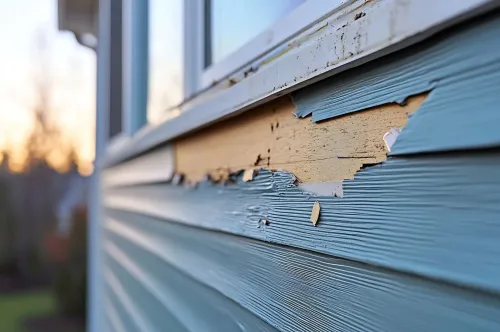
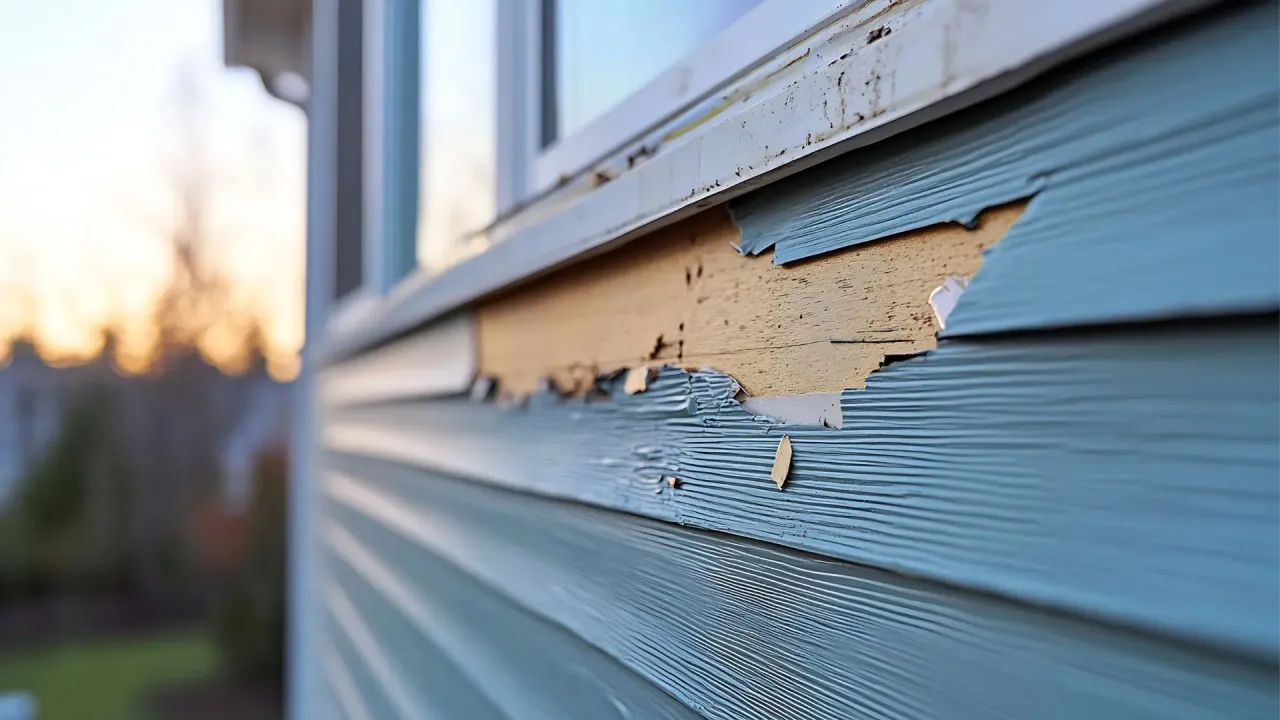
Start with the obvious. A single cracked panel from a one-off impact is a repair. But cracks appearing in several places, especially on the sun-exposed south and west walls, usually mean the material has become brittle with age. Once that happens, every freeze-thaw cycle adds more, and patching becomes a losing game.
Pay attention to gaps as well. Panels that have pulled loose at the seams give water a direct path behind the siding.
2. Warping, Buckling, or Bulging
Run your eye along each wall from the corner, looking down the length of the siding rather than straight at it. Waves, ripples, and bulges show up immediately from that angle.
Warping has two common causes, and both are serious. It can mean the panels were nailed too tightly and couldn't expand and contract with temperature — a workmanship problem that gets worse every year. Or it can mean moisture has swollen the sheathing behind the siding, which points to a leak that's already been active for some time.
3. Soft Spots
Press firmly on the wall in a few places, especially low on the wall, near downspouts, and under windows. It should feel solid. If it gives, feels spongy, or you can push your thumb into it, the sheathing behind the siding is likely wet and beginning to rot.
Soft spots are the sign that most often turns a straightforward siding job into a larger repair, so they're worth catching early.
4. Peeling Paint or Bubbling Wallpaper Inside
This one surprises homeowners, because the symptom shows up nowhere near the siding. Moisture that gets past a compromised exterior travels into the wall cavity, and eventually pushes through interior finishes — lifting paint, bubbling wallpaper, or leaving faint stains along baseboards and window casings.
If you're seeing interior finish problems on an exterior wall with no plumbing in it, look outside for the cause.
5. Heating and Cooling Bills Climbing
If your energy costs have crept up without a rate increase or a change in how you use the house, your building envelope may be the reason. Failing siding, gaps at penetrations, and wet insulation all reduce your wall's thermal performance. Wet insulation is particularly bad — once it's compressed and damp, it loses most of its R-value and doesn't recover.
Replacement is also your best opportunity to add exterior insulation before the new siding goes on, which is one of the most cost-effective upgrades available on an older home.
6. Mould, Mildew, or Moss Growth
Some staining on a shaded north wall is normal and washes off. What isn't normal is persistent growth concentrated at seams, corners, or below windows, or growth that comes straight back after cleaning. That pattern means moisture is being held against the wall rather than draining away, and the cause is usually behind the siding, not on it.
7. Fading, Chalking, and Constant Repainting
Heavy fading is mostly cosmetic on its own. But it tells you the material has taken years of UV exposure and its protective surface is spent. If you're also repainting more often than you used to, or the finish leaves a chalky residue on your hand, the siding is near the end of its service life.
Repair or Replace?
A reasonable rule: if the problem is confined to one area, the rest of the siding is sound, and matching panels are still available, repair it. If problems appear on multiple walls, if you're finding soft spots, or if you've already patched the same house more than once, replacement is the better use of your money.
There's a practical wrinkle, too. Discontinued profiles and faded colours are hard to match, so patches on older siding often look like patches.
Get a Second Opinion Before You Decide
Several of these signs point to conditions behind the siding that can't be judged from the curb. An installer who opens up a section and inspects the sheathing can tell you exactly what you're dealing with — and whether you're looking at a repair or a full replacement.
Clean Cut Siding Inc. serves homeowners across the Waterloo Region with free, no-pressure inspections and honest recommendations. Call 226-505-5319.